Ask three sources for Longboat Key's median home price this year and you will get three different answers, and none of them are wrong. One puts the island-wide median near $1.1 million as of the three months ending in May 2026. Another reports a 2026 single-family median around $2.1 million against a condo median closer to $1.05 million. A third describes the luxury waterfront single-family segment sitting near $2.18 million. A buyer lining these up side by side could reasonably conclude that someone made an error. Nobody did. They measured different islands that happen to share a zip code.
Longboat Key is one eleven-mile barrier island, but it is stitched together from two counties, two price tiers, and two genuinely different ownership experiences, and the seam runs straight through Gulf of Mexico Drive around the 4000 block. If you are comparing Longboat Key to another neighborhood on your shortlist, or weighing two Longboat Key listings against each other, the street address tells you less than which side of that seam the parcel sits on.
The Line at the 4000 Block
North of that point, you are in Manatee County. South of it, Sarasota County. The split is not cosmetic.
Because the island is functionally built out, with the Town of Longboat Key expecting little new growth beyond demolition and replacement of existing structures, this administrative line matters more than it would on a market with room to expand. Renovation and rebuild are how most owners here eventually get the home they want.
A Publix as the Unofficial Border
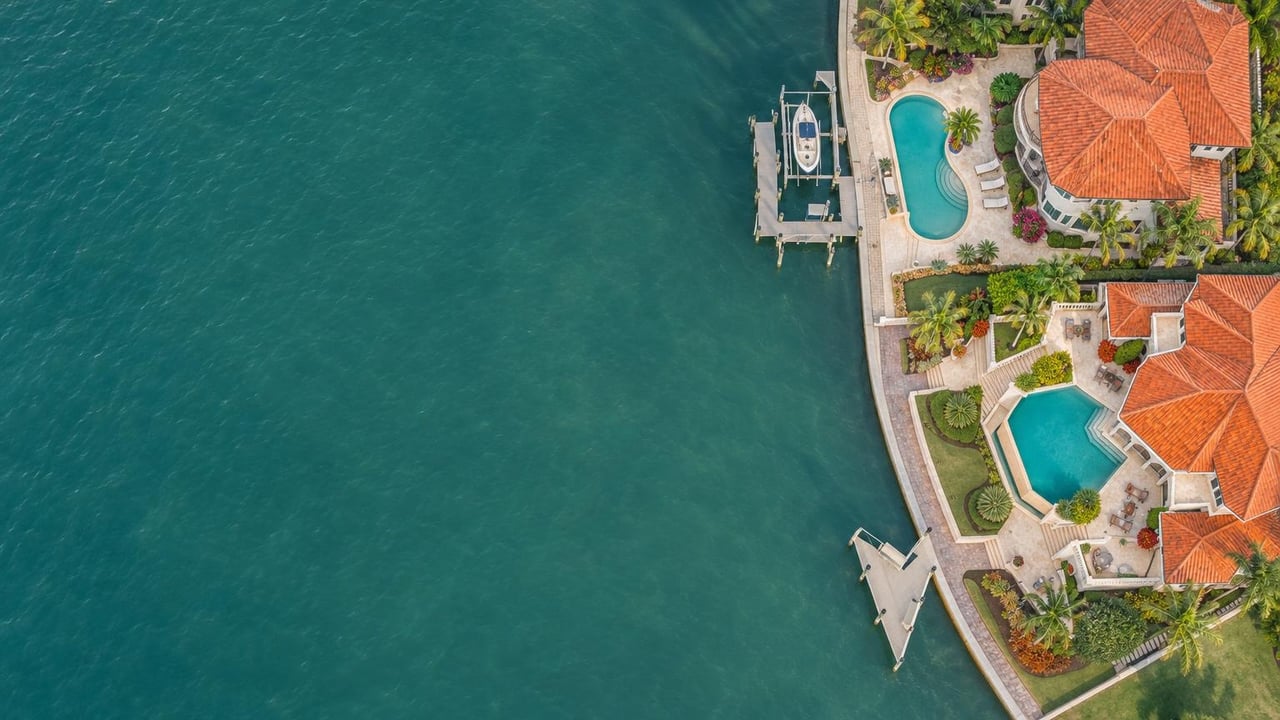
Locals describe the island less by county than by feel, and the feel changes gradually as you move along the single north-south spine. Mid-key, around the Bay Isles Shoppes, the character is practical: a Publix, a pharmacy, the errands that make daily life on a barrier island work. Head north from there and the lots get smaller, the homes skew toward older Florida vernacular architecture, and the water access turns boating-oriented rather than beach-oriented. Head south and the density of amenities rises fast: the Longboat Key Club's golf and marina complex, the gated enclaves of Bay Isles, and the St. Regis Longboat Key Residences all sit within a few miles of each other near the island's southern tip, close to St. Armands Circle and downtown Sarasota.
That difference in character tracks the county line closely enough that it is not a coincidence. The quieter, more residential north end falls in Manatee County. The resort-dense south end falls in Sarasota County. Buyers who want deep-water dock access without paying a gulf-front premium tend to find it on the north end, where a mix of older and newer single-family homes sits at a meaningfully lower price point than the amenity-heavy south.
What Each End Actually Prices Like
| North End (Manatee County) | South End (Sarasota County) | |
|---|---|---|
| Character | Old Florida vernacular homes, boating neighborhoods, smaller lots | Resort-adjacent, anchored by Longboat Key Club, Bay Isles, St. Regis corridor |
| Condo entry point | Established buildings like Seaplace, with units closing near $529,000 in early 2026 | Longboat Key Club towers starting around $800,000 for a one-bedroom |
| Single-family / gulf-front | Older single-family homes from roughly $1 million, with some established communities like Country Club Shores reaching $3.5 million in the same window | Gulf-front single-family homes south of the mid-island bridge routinely listing above $5 million |
| Water access | Deep-water dock access often available without a $3 million price tag | Beach and resort access dominate over private dock premiums |
That $529,000-to-$3.5-million spread inside a single reporting window is not two markets years apart in time. It is one island, one season, two different products. A condo buyer shopping Seaplace and a single-family buyer shopping Country Club Shores are both technically "on Longboat Key," and they are not competing for the same inventory, the same comps, or the same lenders in any meaningful sense.
Why Three Different Medians Can All Be True
Once you see the island as segmented rather than uniform, the conflicting median prices stop looking like bad data and start looking like a map. The 2026 figures showing a single-family median around $2.1 million against a condo median near $1.05 million are not contradicting each other. They are describing two product types that happen to sit on the same landmass. The luxury waterfront figure near $2.18 million is a third slice again, isolating gulf-front single-family from the broader single-family pool that includes bay-side and interior lots.
This matters for how you use a median in practice. If you are shopping the condo tier, the whole-island single-family median is not a benchmark you should be measuring against at all, it sits well above your actual competitive set. If you are shopping a gulf-front estate on the south end, the island-wide blended median understates what you should expect to pay, because it is diluted by every lower-priced north-end and interior sale in the same dataset.
Where a median does become useful is inside your actual segment. Early 2026 data showed a sales-to-list ratio near 91 percent island-wide, which on a $1.5 million property works out to roughly $135,000 of negotiating room if the seller is motivated. That number is worth having in your back pocket, but only once you have already narrowed to the right comps. Applied to the wrong segment, it tells you nothing true.
The County Line Follows You Home
The county split does not disappear at closing. It follows the deed. On an island where rebuilding is the primary form of new construction, this is not a minor administrative footnote.
Before comparing two listings that sit on opposite sides of that line, it is worth confirming a short list of specifics rather than assuming the island behaves as one market:
- Which county the parcel is actually in
- Whether the "median" you are comparing a listing against is drawn from single-family or condo sales, and from which end of the island
- Dock depth at mean low water and whether the water is bay-side or gulf-side, since orientation moves value more within a segment than the county line does across segments
A Few Questions Worth Asking
Does the county line show up on the listing itself? Not reliably. Listing sheets show the address and legal description, not the county. Confirm through the parcel record before assuming which jurisdiction applies.
Does insurance pricing differ north versus south? Insurance is priced primarily on flood zone, construction type, and elevation certificate rather than the county line itself.
Is one end simply the better investment? Neither end is objectively better, they serve different buyers. The north end suits owners who want deep-water dock access without gulf-front pricing. The south end suits owners who want resort infrastructure, golf and marina access, and proximity to St. Armands Circle and downtown Sarasota.
Longboat Key rewards buyers who stop asking what the island's home prices are doing and start asking what their specific segment, on their specific side of the county line, is doing. That distinction is easy to miss from a national portal and obvious once someone walks the comps with you building by building. If you are weighing a purchase here, or sizing up what a sale elsewhere in Sarasota or Manatee County would net you first, the team at Jennifer Linehan Group can walk the actual comps with you segment by segment. Start with a clear picture of what you're working with: Get a Free Home Valuation.
This article is general information, not legal, tax or financial advice. Consult a qualified professional about your situation.